

FY 2026 Advanced International Collaborative Research Program - Adopting Sustainable Partnerships for an Innovative Research Ecosystem (ASPIRE) [8th Call (Alignment) ]
Outline
| Status of Grants/Funding Opportunities | Pre-announcement |
|---|---|
| R&D phase | Basic Study, Applied Study, Nonclinical Study/Pre-clinical Study |
| Key Fields | Project for Seeds Development and Research Base |
| Start Date | Late April, 2026 (Tentative) |
| Contact |
|
Public offering content
AMED will provide advance notice of the upcoming the Alignment Call※1 of ASPIRE program.
Support for each project will be as follows.
Up to 100 million yen per year including direct and indirect costs for a duration of 5 years.
For more information, please refer to the call text at the time of the call for applications.
※1 Alignment Call
AMED will accept research proposals in which Japan-based research teams plan to collaborate with top foreign scientists who have been receiving or will receive sufficient research funding from their country or regional founding agencies (either public or private).
Research areas
1. Individual Differences and Disease Onset Mechanisms
This research area focuses on elucidating individual differences and mechanisms of disease onset at the molecular and cellular levels, considering interactions among the genome, epigenome, genetic factors, and environmental influences.
Examples: Innovative cancer medicine; genomic medicine; genome, epigenome, transcriptome analyses; statistical genetics; biomarkers; epidemiology; etc.
2. Maintenance and Disruption of Biological Systems
This research area focuses on elucidating the mechanisms by which biological homeostasis is maintained, as well as the mechanisms by which homeostasis is disrupted during disease development.
Examples: Immunity; inflammation; aging; infectious diseases; microbiome research; antiviral drugs; novel antibiotics; antimicrobial resistance; liquid biopsy; etc.
3. Control, Creation, and Reconstruction of Biological Functions
This research area focuses on understanding, controlling, creating, and reconstructing biological functions—leveraging approaches such as regenerative medicine and bioengineering to explore the dynamics of living systems.
Examples: Regenerative and cell therapies; gene therapy; stem-cell-based therapies; gene editing and synthesis; synthetic biology; multimolecule control; bioengineering; inter-organ communication; drug discovery and design; molecular targeting; cross-disease regulatory mechanisms; neuroscience; brain-inspired intelligence; etc.
Partner countries and regions
United States, European Union, Italy, Austria, the Netherlands, Sweden, Spain, Czech Republic, Denmark, Germany, Finland, France, Belgium, Poland, Portugal, the United Kingdom, Switzerland, Norway, Canada, Australia, Korea, and India
(As of March, 2026)
※With respect to India, only the ASPIRE Exchange Type administered by JST is to be included.
Program summary
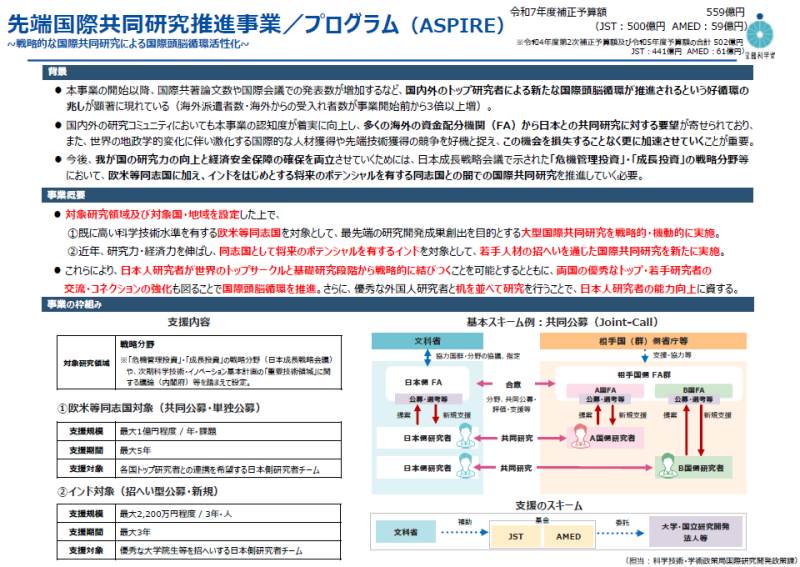
- Adopting Sustainable Partnerships for Innovative Research Ecosystem (ASPIRE) aims to provide sufficient funds for large-scale collaborative joint research projects in cutting-edge fields, to be conducted at the initiative of the Japanese government in collaboration with advanced countries with high standards of science and technology.
- In cooperation with funding agencies in Japan and the partner country, this program provides strategic support for international joint research with flexible research budgets and support periods.
- Through this international research collaboration, Japanese researchers will be encouraged to join the world’s leading scientific community. The exchange and connection of excellent young researchers from Japan and partner countries will also be strengthened. This will promote international talent mobility and circulation and contribute to long-term collaborative networks.
- Proposal solicitation, evaluation, adoption, support, etc. in this program will be conducted by the Japan Agency for Medical Research and Development (AMED) and the Japan Science and Technology Agency (JST), and AMED will support research projects in the field of “Healthcare”.
Program Details
Solicitation Period
03/12/26
Last updated 03/12/26